|
©The Archaeological Settlements of Turkey - TAY Project
|
|
|
|
|
 |
Binbirkilise 15 |
|
|
|
|
For site maps and drawings please click on the picture... 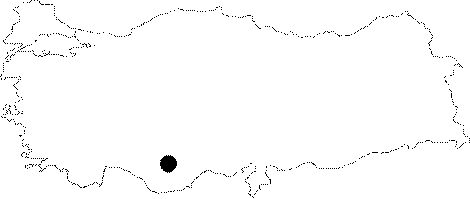 |
For photographs please click on the photo...  |
|
|
|
|
Type:
|
Church |
|
Plan Type:
|
Basilica |
|
Year of Costruction:
|
|
|
Phase:
|
Early |
|
Investigation Method:
|
Survey |
|
Altitude:
|
|
|
|
|
|
Region:
|
Central Anatolia |
|
Province:
|
Karaman |
|
District:
|
Merkez |
|
Village:
|
Madensehri |
|
Antique Name:
|
Barata |
|
|
|
  |
|
| Location: It is located on the north of the structure no. 10 in Madensehri Village in Merkez District of Karaman Province. |
| Geography and Environment: It is situated at the edge of the small chimney among the ruins of Yukariören [Eyice 1971b:42]. Since there are a lot of church remains around Madensehri Village, the churches in the region are called Binbirkilise and the structures are named with numbers. |
| Research and Excavation: It was surveyed by W.M. Ramsay and G.L. Bell. |
| Description: Architectural Features: The church is in basilical plan with three naves. The narthex has three sections and the arched door here provides a passage to the naos. The naves are divided by three pillars. In the later period, the basilica is transformed into a mosque and a niche for mihrab is opened on its south wall. The walls underwent renovation and Byzantine grave stones are used as spolia [Eyice 1971b:42-43]. Decorative Features: No decoration belonging to the Byzantine period is found. Only a cross relief can be seen on the lintel of a door [Eyice 1971b:42]. |
| Finds: During the cleaning studies carried out by W.M. Ramsay and G.L. Bell, the rubbles were removed and and various remains were found. A minbar made out of stone steps was found in front of the south wall of the naos. At the center of the small room added to its north, a trough with a diameter of 2 m was found. This trough is made out of monolith stone and it sit on three pillars. It was regarded as piscina by W.M. Ramsay-G.L. Bell and Crowfoot. However Eyice believed that it could be lavatory of the mosque. The trough doesn't exist today. It is ornamented with a zigzag decoration that encircles the external surface. The door of the small room where the trough was found opens to the north and on the door lintel there was an inscription reads as "Do poor Loukias a favor" [Eyice 1971b:42-43]. |
| Interpretation: |
| Destruction: |

