|
©The Archaeological Settlements of Turkey - TAY Project
|
|
|
|
|
 |
Spridon Kilisesi |
|
|
|
|
For site maps and drawings please click on the picture... 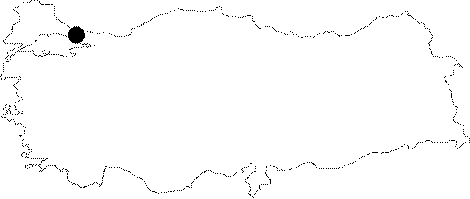 |
For photographs please click on the photo... 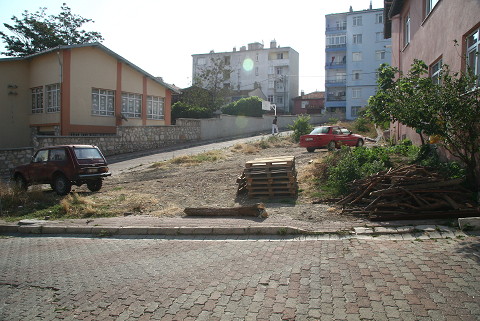 |
|
|
|
|
Type:
|
Church |
|
Plan Type:
|
|
|
Year of Costruction:
|
6th c. |
|
Phase:
|
Early |
|
Investigation Method:
|
Survey |
|
Altitude:
|
35 |
|
|
|
|
Region:
|
Marmara |
|
Province:
|
Istanbul |
|
District:
|
Silivri |
|
Village:
|
|
|
Antique Name:
|
Selymbria |
|
|
|
  |
|
| Location: Once located across the present Primary School of Turgut Reis in the Silivri District of Istanbul, the church is now completely demolished. Tas Mektep Street is to the west of the Turgut Reis Primary School and Tavanli Çesme Street is to the south. |
| Geography and Environment: Silivri maintained its significance throughout the Byzantine Period with its sound castle as well as being a site preferred for residential suburb. It is known that the Emperor Leon I (457-474) lived here during his reign. As it was located on the coastal road linking Byzantium to the west, Selymbria had a major role as a remote station of the capital. |
| Research and Excavation: It was surveyed by S. Eyice in 1960s. |
| Description: Building Phases: There are two building phases. Originally it was dated to the 6th century, and then it underwent some modifications during the Mid-Byzantine Period. The naos is from the 10th-12th centuries. It was completely renovated by the rich Greeks of Silivri in 1881, and was reopened for service in 1905. As the building was left in ruins for a long period of time before it was restored, the building materials were used by the local people for different purposes. The building lost its originality entirely during the salvage operations due to use of inefficient and cheap material and as it was in ruins. It vanished recently [Eyice 1969a:354-357]. Architectural Features: With a cross in square plan, it had a projecting bema section separated from the naos through an iconostasis, a projecting apse, and a narthex covered by a wooden roof surmounted by a gynekaion. The dimensions were as follows; 14.35 m in length including the bema section, 9.2 m in width, 6.7 m in height up to the drum of the dome while the diameter of the dome was 5.2 m, and the narthex was 2.25 m wide. The dome was supported by four columns, and had a high hexadecagonal drum. The exterior architecture of the church bore the characteristics of the Late Byzantine Period [Stamoulis 1938:37]. Decorative Features: The interior of the church was decorated with several frescoes and icons, but it seems that as if they were made in a rush [Stamoulis 1938]. |
| Finds: There is a column fragment in the garden of Turgut Reis Primary School [TAYEx 12.08.2008]. |
| Interpretation: According to S. Eyice, the remains that were removed during the construction of the school building in 1968 might have been remains of the Spyridon Church [Eyice 1969a]. It is known that the walls of the church were buried 1 m into the ground for centuries [Stamoulis 1938]. Thus, it is believed that the remains may not have been entirely vanished, and an excavation in the field adjacent the Turgut Reis Primary School may yield traces of the foundations of the building. |
| Destruction: |

