|
©The Archaeological Settlements of Turkey - TAY Project
|
|
|
|
|
 |
Basara Güney Kilise |
|
|
|
|
For site maps and drawings please click on the picture... 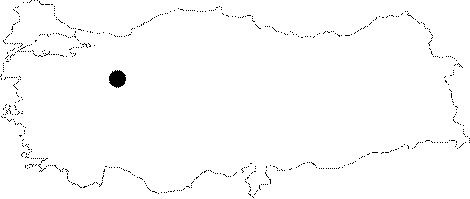 |
For photographs please click on the photo...  |
|
|
|
|
Type:
|
Church |
|
Plan Type:
|
Cross in Square |
|
Year of Costruction:
|
First half of 5th c. |
|
Phase:
|
Early Middle |
|
Investigation Method:
|
Excavation |
|
Altitude:
|
1179 |
|
|
|
|
Region:
|
Central Anatolia |
|
Province:
|
Eskisehir |
|
District:
|
Han |
|
Village:
|
Basara |
|
Antique Name:
|
Atyien |
|
|
|
  |
|
| Location: It is located near Basara Village, 5 km southeast of Han District of Eskisehir Province. It is situated on the south of the village, 430 m far from the center of the village. |
| Geography and Environment: Basara Village is situated at the northeast edge of Mountainous Phrygia, on the road originating from Dorylaion and heading to Santabaris, Kedra and Polybotos during the Byzantine Period. It is founded on the northern slope of the low valley which was formed by the gulley came from the ridges on its west. It is located 100 m east of the Northern Church. There is a multi-roomed structure, remains of which can be barely seen, on the south of the gulley. The function of this structure is not clear. To its southwest, the necropolis of the ancient settlement is located. The multi-roomed structure is called "Southern Complex" and dated to Late Antiquity. In the necropolis on the southwest, there are five graves found in total. Two of them are rock-cut chambered tombs. Two of the rooms are in square shaped while one of them is in rectangular plan. In the beginning of the road heading to Han, there is a structure, the foundations of which were discovered during the mid of the last century. It is thought that the structure could be a grave due to the large fragments of stele. |
| Research and Excavation: It was exposed during the excavation conducted under the directorship of Eskisehir Archaeological Museum and consultation of Assistant Professor Oguz Alp from Anadolu University [Alp 2010:24-27]. No research was carried out before the excavation. |
| Description: Building Phases: The traces and the other remains show that the Southern Church was in basilica plan during the Byzantine Period. However, it was reconstructed as in the form of cross in square plan by making some changes in the crutch and roofing system in the Middle Byzantine Period. After it was abandoned, it was used by Turks for different purposes. The structural changes, which might belong to the period after the 12th century, represent the third building phase of the church. Architectural Features: Including the apse, the exterior section measures 25.60 m in length and 14.10 m in width. The external walls of the church, which are preserved up to date, might belong to the Early Byzantine Period. The apse, west entrance door and narthex preserved their original form in the first building level. In the Middle Byzantine Period, the church was rebuild in the plan in accordance with the architectural aspects of the period. The intercolumniations of the old church were removed and a row of rectangular shaped pillars was added together with the wall pillars added to the walls of the lateral nave. The arrangement of the support system indicates that in the second building phase, the vaulted cross-arms, opening to the domed unit in front of the bema, were in plan that could be called a variation of the cross in square. The second and the third pillar of the row of supports bordered the western cross-arm, which were preserved up to date, were extended in the form of "T" for the purpose of placing the stiffening arches supporting the vault inside. The wall pillars of various sizes were added in front of the side walls of the rectangular rooms, which were formed among the cross-arms, for the purpose of supporting the roof. The second wall that surrounds the apse and extends towards the south corner of the structure was build. This wall supporting the apse outside might have been built for reducing the pressure caused by the changes made in the roofing system. When this wall reaches to the southeast corner, it turns to the outside and forms an additional apsidal room. The entrance of this room, the function of which is not clear, opening to the southern nave was closed in the later period. In this phase, the square shaped entrance hall, which provides a passage to the structure, was added in front of the west door and the entrance was provided from the north. The external dimensions of the baptistery located immediately south of the church are 5.90x5.90 m. The monolith piscine made out of white marble is in the form of cross on the outside, and four leaf clover on the inside. It extends in the east-west direction and has two steps. The Baptistery might be contemporary with the early phase (5th century) of the church. |
| Finds: Inside the church, stairs and platform belonging to the Ambon made out of tuff and cathedra were recovered. These liturgical elements might belong to the Middle Byzantine Period. The coin found in the fill on the top of the floor could be the proof that the second building phase took place the years before 1065-1070. In addition to this, the bracelet fragment made out of nickel and copper composition, the similar kinds of which can be seen in the neighboring settlements and the museums of the region, shows contemporary features in terms of material and decoration with the coin. |
| Interpretation: Based on the inscription found in Han, W.M. Ramsay claimed that Basara is Kakkabakome. However he changed his mind and claimed that Han might be the settlement that he mentioned [Ramsay 1887:500-501; Ramsay 1890:233]. O. Alp, on the other hand, stated that it is most likely that the ancient settlement near Basara Village could be Atyien based on the votive stele, the settlement was named after, belonging to the Roman Period found during the excavation [Alp 2010:22]. |
| Destruction: |

