|
©The Archaeological Settlements of Turkey - TAY Project
|
|
|
|
|
 |
Seyitgazi Kilise Mozaigi |
|
|
|
|
For site maps and drawings please click on the picture... 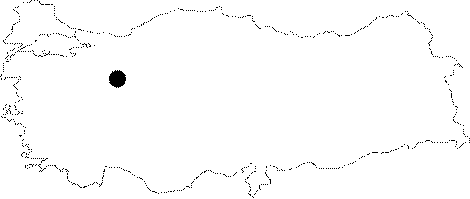 |
For photographs please click on the photo...  |
|
|
|
|
Type:
|
Church |
|
Plan Type:
|
Unknown |
|
Year of Costruction:
|
|
|
Phase:
|
Early |
|
Investigation Method:
|
Excavation |
|
Altitude:
|
960 |
|
|
|
|
Region:
|
Central Anatolia |
|
Province:
|
Eskisehir |
|
District:
|
Seyitgazi |
|
Village:
|
Ikiçesme Mah. |
|
Antique Name:
|
Nakoleia |
|
|
|
  |
|
| Location: It is located in the courtyard of the house owned by Abdülkerim Görgülü who lives in Karaköprü Avenue, No: 32, Ikiçesme Quarter in Seyitgazi District of Eskisehir Province. |
| Geography and Environment: The mosaic of the church is located in the center of Seyitgazi District. After it was excavated, it was covered by soil. Seyitgazi District is located in the southeast of Eskisehir Province, on Eskisehir-Afyon road, 42 km far from the city center. It was one of the important settlements during the Hittite and Phrygia periods. During the Roman Period, it was remained within the region of Phrygia Epictetus. It was known as Nacolea in Roman Period. The city has gained importance due to its important location in terms of military and trade and it minted its own coins. The center is located on Parthenios Creek (Seyit Su) that was one of the branches of Sangarios River. The city became strategically important due to the roads in the region. Nacolea is located in the south of Dorylaeum and on the road heading to one of the important trade centers, Apameia. It is surrounded by Prymnessos, Dokimeion with marble quarries, Synnada and Euphorbium centers from the south. The city maintained its importance during the Byzantine Period as well and it was mentioned under the name of "Nakoleia" in the inscriptions and sources belonging to the Byzantine period. After a while, the city was promoted to the archiepiscopate and it maintained its importance as a metropolitan until the beginning of the 11th century. Due to the Turkish raids, Nakoleia fell from power and the city was lastly seen on the list of Dioceses in the 14th century. Apart from the church, which was excavated and the apse mosaic of which was unearthed, no other Byzantine structure that survived up to date was found in the district and the vicinity. However, a great number of various architectural plastics (capitals, cornices, slabs and fragments of architrave, piscine etc.) that are being displayed in the museum inside Seyitgazi Külliyesi show the existence of religious structures in this region. In the sources, the existence of St. Mikhael Church was mentioned as well [Mango 1986:45]. Only some wall remains of Byzantine Castle located in the area known as Kalebayiri, opposite the hill where Battal Gazi Külliyesi was built, in the southeast of Seyitgazi District survived up to date. In the Ottoman miniatures of the 16th century (Matrakçi Nasuh), the whole castle can be seen. There is a necropolis on the rocky slope in the east of Sükranli Village of Seyitgazi District. The rock graves belonging to Byzantine Period are in cross plan and covered by barrel vault. |
| Research and Excavation: The excavations were initiated in 1997, when the church mosaic in Seyitgazi was found during a wastewater drainage excavation. The results of the salvage excavation carried out in the area near Eskisehir Archaeological Museum were published by M. Fuat Özçatal [Özçatal 1997:529-550]. |
| Description: Architectural Features: The mosaic is located inside the apse that is in the form of semicircular both inside and outside. The apse measures 4.00x6.60 m and the wall is 82 cm in width. There is another foundation with a width of 70 cm, adjacent to the apse and it extends towards the north. This foundation was built in the same technique and material. As a result of the excavations carried out in this area, the mosaic was unearthed at a depth of 2.20 m under the current ground level. The mosaic is located 1.10 m away from the circular section of the apse and it was built in accordance with the shape of the apse. It measures 2.60x2.75 m. The mosaic covering an area of about 6 square meters was formed with cubical stones in white, blue, red, orange and oyster white. The mosaic in "Opus Alexandrinum" technique consists of cusped rosettes. The middle section of the square frame in the center was left empty. The foot of the altar should have been placed in this section. There is a "tabula ansata" bearing a three-line Greek inscription in the upper section of the mosaic that is framed with an interlace motif. The inscription reads as "The prosecutor of the city of Nakolea, FIavios Eusebios prayed with Helen and placed this mosaic." The cross and ivy motifs placed in circle were employed on the tabula ansata. Each rosette motif in the center bears cross motifs, the ends of which are decorated. The mosaic was placed on the blockage built with broken stones and powdered bricks. The sides of the mosaic were framed with quite formless stones and spolia stones were also used. There are two marble gutter stones of poor quality, placed parallel to each other, between the mosaic and the apse. |
| Finds: The excavations yielded 114 glass objects. These are separated as 21 rim sherds, 6 candle sticks, 3 bases, 4 lugs, 32 window glass, 1 girdle, 1 inlayed glass (embedded) and 76 body sherds. The glass objects are mainly dated to the 6th-7th century. 50 unglazed wares in total were found during the excavations. They belong to vessels such as bowl, amphora and jug. Among the wares, there are painted pottery belonging to Roman Period and Byzantine pottery. It is discovered that these pottery sherds commonly belong to cooking pots. The wares are mainly dated to the Middle Byzantine Period and some of the amphora sherds belong to the 6th-9th century. 53 metal finds, recovered during the excavations, contain 1 candle hanger, 1 hook, 1 arrowhead, 14 nails and tacks and 34 lead candlewick holders. One of the interesting find among the findings is the candle hanger that was found intact. The arms of the three-sectioned bronze hanger are flat and there are hooks on the ends. The hook that links the arms and used for hanging the candle are in the shape of cross. The similar candle hangers are dated to the Early Byzantine Period. |
| Interpretation: Based on the sources, it is known that St. Mikhael Church was located in Nakoleia [Mango 1986:45]. The structure in which the mosaic was unearthed could be St. Mikhael Church. |
| Destruction: |

