|
©The Archaeological Settlements of Turkey - TAY Project
|
|
|
|
|
|
Tatarli Tümülüsü |
|
|
For site maps and drawings please click on the picture... 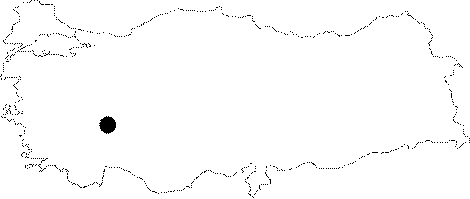 |
For photographs please click on the photo...  |
|
Type:
|
Tumulus |
|
Altitude:
|
m |
|
Region:
|
Aegean |
|
Province:
|
Afyonkarahisar |
|
District:
|
Dinar |
|
Village:
|
Tatarli |
|
Investigation Method:
|
Excavation |
|
Period:
|
Late Phrygian |
|
|
|
  |
|
| Location: The Tatarli Tumulus is located on the Suhut-Dinar Motorway, 145 km away from Afyonkarahisar, and 35 km away from Dinar. It was founded on a rocky hill to the west of the Tatarli-Suhut road, 3 km northeast of the Tatarli Town. |
| Geography and Environment: |
| History: |
| Research and Excavation: Upon rumours on the destruction of the mound by treasure hunters and smugglers in 1969, the Museum Director H.T. Uçankus and his colleagues B. Yalman and A. Kiliçkaya conducted a salvage excavation in the tumulus in 1970. |
| Stratigraphy: |
| Small Finds: Grave: It is a 6 m high tumulus with a diameter of 50 m. It rests on a natural and rocky hill in north-south direction. The height from the top of the tumulus down to the ceiling of the grave chamber is 3.5 m. The grave chamber is 1.85 m high. The thickness of the beams covering the chamber is 20-30 cm. A vaulted grave chamber was built using the juniper timbers on a leveled ground. The roof was covered after the burial was placed into the chamber, and then a thick wall was built around it using cut stone blocks in corbelling technique. Finally a pile of protective soil layer was composed including bulb stones, ballasts, pebbles, and soils in various colors. There are no windows or doors in the grave chamber. The internal dimensions are 2.5x2x1.85 m. The northern wall of the chamber was built using 8 wooden beams in different dimensions. The top four beams were tied with nogs and the others were superimposed without any use of nogs. Overlap and corbelling techniques were applied for construction of beam walls. The beams of the roof were also laid side-by-side in the form of overlaps, covered by rafters, and then barks and finally plastered with clay mud. During the Roman Period, a dromos of stone blocks was attached to the grave chamber, and used as a family cemetery. Fourteen human skeletons and skulls were recovered from the cemetery. The locations of the bones also suggest multiple use of the burial chamber. The Phrygian grave, which was presumably rich, was plundered during the Roman Period, lasting until today. The excavations yielded limited number of small finds including a copper Roman coin, two iron nails, a glass bottle fragment and a terracotta sherd at Tatarli Tumulus. The painted drawings on the walls of the wooden grave are the most interesting and important finds of the tumulus. There are two sphinx friezes facing each other on the upper section of the northern and southern walls. The figures under them consist of various rich mythological scenes in a series of painting such as warriors holding shields, parade of chariots of war, winged bulls, flying birds chased by a panther. Also found are some depictions of human beings, animals and geometric figures on the side walls. |
| Remains: |
| Interpretation and Dating: Based on the construction technique of Tatarli Tumulus, construction style of the wooden chamber, figures and paintings on the wooden walls, it is likely that the grave belongs to the Late Phrygian Period, i.e. late 6th century BC (525-500). A recent dendrochronological study by P. Cuniholm suggests the date of 531 BC. |

