|
©The Archaeological Settlements of Turkey - TAY Project
|
|
|
|
|
|
Myus |
|
|
For site maps and drawings please click on the picture... 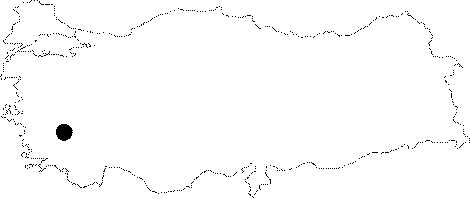 |
For photographs please click on the photo...  |
|
Type:
|
City |
|
Altitude:
|
m |
|
Region:
|
Aegean |
|
Province:
|
Aydin |
|
District:
|
Söke |
|
Village:
|
Avsar |
|
Investigation Method:
|
Excavation |
|
Period:
|
|
|
|
|
  |
|
| Location: It is situated to the northwest of the Avsar Village; south of the Soke District of the Aydin Province. It is accessible after a two hours walk from the Avsar Village [Bean 1976:602]. Used to be a peninsula during the Ancient Period, Myus now lies 100 m south of the Meander River, 15 km northeast of Miletus. At present, it is called Avsar Kalesi. |
| Geography and Environment: The alluvions washed down by the Meander River blocked Myus' access to the sea [Bean 2001:225-226]. During the period of Strabo, Myus was located thirty stadion (800 m) off the shore, accessible only with small boats. The city consists of a small hill, inclining from south to north, which also include sacred monuments. On the lower slope of the hill there are two successive rocky terraces. It is known that during the Ancient Period a temple stood on each of these terraces. The main city with ruins of domestic structures and cisterns carved into the rocks lies to the northeast of the temple hill [Akurgal 2000:397-398]. |
| History: |
| Research and Excavation: Myus was first excavated in 1908 by Th. Wiegand [Akurgal 2000:397-398]. Later on, excavations were conducted in 1964 and 1966 by Weber on behalf of the German Archaeological Institute in Istanbul. |
| Stratigraphy: |
| Small Finds: Architecture: The excavations conducted by Wiegand revealed Archaic architectural elements, which were reused in the Theatre, Temple of Athena and Stadium. According to Wiegand, the Temple of Apollo Termintheus stood on the upper terrace, and the sanctuary on the lower terrace was the Temple of Dionysus referred by Pausanias. Some of the fragments bear inscriptions about Myus and the Temple of Apollo Termintheus. Published by P. Hermann, these inscriptions support identification of Avsar Kalesi as Myus. The remains of the temple partly visible on the surface became prominent during the excavations in 1964-66 led by H. Weber. The Archaic reliefs depicting chariot-racings and reused in a wall of a later period were sent to Berlin by Wiegand. Weber exposed foundations and architectural elements of the Temple of Dionysus on the lower terrace, however according to Weber, no evidence exists for dedication to Dionysus. It is also proposed that Apollo Termintheus and Poseidon may have been the deities of this temple. It is believed that the reliefs depicting chariot-racings which have been already exhibited in Berlin should have belonged to a frieze decorating the outer wall of the cella. Weber dated the temple to the mid-6th century BC based on the style of these reliefs and fragments of decorations with egg patterns again preserved in Berlin. The excavations conducted in the upper terrace in 1964 by Weber revealed initiation of a construction of a temple in Ionian order during the Late Archaic Period. It is larger than the one in the lower terrace; but it seems that the construction was stopped before the columns were erected. Other than these finds, an Archaic niche carved into the rocks and Archaic walls which support the upper terrace, and constitute lateral side of the lower terrace were uncovered [Akurgal 2000:397-398; Weber 1967: 31]. |
| Remains: |
| Interpretation and Dating: One of the 12 Ionian cities, Myus was taken from the Carians by Cyaretus or Cydrelus, a son of Codrus [Strabo 2005:14,1,16]. Myus contributed to the Ionian fleet with three ships in the Battle of Lade in 494 BC. The city paid a tribute of 1 talent to the Delian League. She was a member of the Panionion, however played no significant role in the history, and became a surbordinate of Miletus in early periods. According to Pausanias, the mud coming the Meander River silted up the Bay of Myus, and the inhabitants abandoned the city due to increase in number of mosquitos. Inhabitants of Myus took all of their movable assets together with cult statues and moved to Miletus. Pausanias informs that only the Temple of Dionysus made of white marble was extant during his period. |

