|
©The Archaeological Settlements of Turkey - TAY Project
|
|
|
|
|
|
Myus |
|
|
For site maps and drawings please click on the picture... 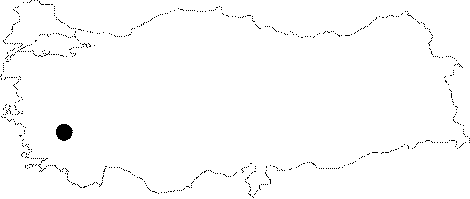 |
For photographs please click on the photo...  |
|
Type:
|
City |
|
Altitude:
|
m |
|
Region:
|
Aegean |
|
Province:
|
Aydin |
|
District:
|
Söke |
|
Village:
|
Avsar |
|
Investigation Method:
|
Excavation |
|
Period:
|
Classical Hellenistic Roman |
|
|
|
  |
|
| Location: It is situated to the northwest of the Avsar Village; south of the Soke District of the Aydin Province. It is accessible after a two hours walk from the Avsar Village [Bean 1976:602]. Used to be a peninsula during the Ancient Period, Myus now lies 100 m south of the Meander River, 15 km northeast of Miletus. At present, it is called Avsar Kalesi. |
| Geography and Environment: The alluvions washed down by the Meander River blocked Myus' access to the sea [Bean 2001:225-226]. During the period of Strabo, Myus was located thirty stadion (800 m) off the shore, accessible only with small boats. The city consists of a small hill, inclining from south to north, which also include sacred monuments. On the lower slope of the hill there are two successive rocky terraces. It is known that during the Ancient Period a temple stood on each of these terraces. The main city with ruins of domestic structures and cisterns carved into the rocks lies to the northeast of the temple hill [Akurgal 2000:397-398]. |
| History: Myus; actually being one of the 12 Ionian cities; was taken over from the Carians; according to the legend; by the son of Codros named Kyaretos [Pausanias 7; 2; 10) or Kydrelos [Strabo 14; 1; 16]. According to Strabo [Strabo 14; 1; 3] Myus; was given by Xerxes to Themistocles to supply fish. Myus contributed only 3 ships to the Ionian navy during the Battle of Lade in 494 BC. The city paid 1 talent tribute to the Delian League. It is known that Myus had a disagreement with Miletus over a land in 390 BC. As Polybius [Polybius 16; 24; 9] informs; Philip V presented Myus to the Magnesians in return for the figs when he captured the city. At the beginning of the 2nd century; Miletus laid claim on the sacred territory of the principal deity of Myus; Apollo Terbintheus. Soon after the city fell under the control of the Milesians. She lost its political independence from the Hellenistic Period. It is known that both cities had a sympoliteia at the time of Strabo; and Myus was accessible by small boats on the river [Strabo 14; 1; 16]. After a while an inlet of the Meander River (probably present Lake of Azap) became a lagoon; and turned into a moor; and mosquitos became so intense from the flooding that the inhabitants abandoned the city and moved to Miletus [Pausanias 7; 2; 11; Bean 2001:225-226; Bean 1976:602-603; Weber 1967a:31]. |
| Research and Excavation: In addition to the excavation by Wiegand in 1908; excavations were carried out by Weber from the Istanbul German Archaeological Institute in Myus in 1964 and 1966. It takes place in the registered archaeological sites list prepared by Ministry of Culture and Tourism. |
| Stratigraphy: |
| Small Finds: |
| Remains: The remains of the city are concentrated on the northern slope of a hill. The traces of houses; graves and cisterns carved into the rock are observable. Absence of any statues; inscriptions; or a processed stone is explained by the relocation of the citizens to Miletus [Bean 2001:227]. Temple/Sanctuary: The Temple of Dionysus: It is situated below the fortress from the Byzantine Period on the lower of the two terraces. With 10x6 columns; it is in Ionic order; and measures 30x17 m. Similar to the Sanctuary of Artemis in Magnesia and Ephesus; the façade faces west. It has a deep pronaos; and there is no ophistodomos. What survived to today is only a marble column. It is dated to 540 BC [Weber 1967a:31]. The Temple of Apollo: It was built on the higher of the two terraces below the fortress. Only part of the foundations survived to today; and the temple is 17 m wide. It is larger than the Temple of Dionysus. It is in Doric order. It is likely that it was dedicated to Apollo Terbintheus; the principal deity of Myus [Bean 1976:603; 2001:227]. |
| Interpretation and Dating: |

