|
©The Archaeological Settlements of Turkey - TAY Project
|
|
|
|
|
|
Laodikeia Katakekaumene |
|
|
For site maps and drawings please click on the picture... 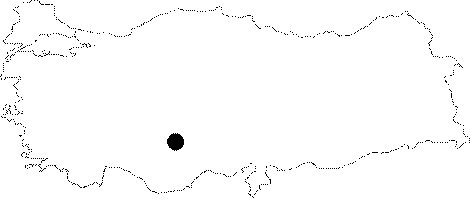 |
For photographs please click on the photo...  |
|
Type:
|
City |
|
Altitude:
|
m |
|
Region:
|
Central Anatolia |
|
Province:
|
Konya |
|
District:
|
Sarayönü |
|
Village:
|
Ladik |
|
Investigation Method:
|
Survey |
|
Period:
|
Roman Hellenistic |
|
|
|
  |
|
| Location: It is located at the 40th km of the Konya - Afyonkarahisar motorway; 10 km southwest of the Sarayonu District; northwest of the Konya Province. |
| Geography and Environment: Laodicea Catacecaumene is situated on a fertile slope of the Sultan Mountains. |
| History: The city should have been founded by Seleucus Nicator I or his son Antiochus during the Seleucids Period ca. 262 - 261 BC. During the Roman Period; the city territorium extended up to Iconium to the south including the imperial land covering the area of Sizima Village. Being renamed after the emperor Claudius during his reign; she minted coins under the name of Claudiolaodicea during the periods of Emperor Vespasian (69 - 79 AD); Titus and Domitian (70 - 79 AD)[Gokturk 1997: 54]. The coinage minted during the Antoninus period is also known. The city became a part of the Province of Pisidia in 297 AD; and was called Laodiceia around 340 AD. Then it became part of the Province of Lycaonia. During the reign of Epiphanius; the city was renamed as Catacecaumene (Combusta); which meant "burnt" ca. 374 - 375 AD. It was proposed that the city took this name because of the desert-like view after the trees were chopped for mining activities [Drew-Bear 2001: 248]. Laodicea Catacecaumene had an important status due to rich ore beds of lead and mercury; and its strategical location as a meeting point of the eastern and western roads. The rich mines within the territorium of the city; which served as a military basis due to its strategical location during the Hellenistic Period; were operated on behalf of the Empire until the period of Tiberius-Vespasian and Domitian; and the income was directly sent to Rome. This resulted in somewhat a fall in the economical level of the wealthy city. Poor number of inscriptions from the 2nd and 3rd centuries AD is an indication of this fall. The city started to regain its significance after the change of procedures during the Late Imperial Period. And; an elite cavalry regiment called "lanciarii" was deployed in the city during that period. Also; it is known that special horses were raised here for pulling the commercial vehicles during the 3rd century AD; and these horses were protected by the Zeus Phatnios cult. The poetic language observed in the inscriptions is an indication of the well developed culture of the people of Laodicea Catacecaumene. The development continued throughout the Early Christianity Period. |
| Research and Excavation: The mound of Ladik at the Tepe Quarter of the Ladik Town was investigated during the surveys conducted by H. Bahar in 1995. The epigraphical findings related with ancient city were uncovered during the surveys carried out by H. Bahar and T. Drew-Bear between 1997 - 2002. |
| Stratigraphy: |
| Small Finds: |
| Remains: Finds dating to the Hellenistic and Roman periods of Laodicea Catacecaumene were found on the surface of a mound; which measures 500x500x50 m; located at the Tepe Quarter of the Ladik Town [Bahar 1997: 364]. Inscriptions are the only other remains of the city besides some surface finds. The craftmanship signboard found in the marketplace is a rare example from the Roman Period in Anatolia. It refers to professions such as carpentry; masonry; brick-making. Very few information is available about the city plan. It is believed that the findspot of two honorary inscriptions recovered in situ actually might have been on the main street of the city. Based on the inscriptions; it seems that the Christianity was adopted starting 240 AD; and widely accepted ca. 300 AD Among the finds is the epitaph of Julius Eugenius; who was dismissed from the army as he insisted on keeping his faith; and later on became bishop of Laodicea Catacecaumene. A church which was built by the bishop in the city has similar architectural characteristics with the St. Paulus church of the Pisidian Antioch; and is dated to the same period (beginning of the 4th century AD). |
| Interpretation and Dating: |

